
Agonistic Assemblies : On the Spatial Politics of Horizontality
23,95 €
Neuf · Vendu par Cultura FR · Prix à revérifier. Prix, stock et livraison à confirmer chez le marchand. Chercho partage cette offre et ne vend pas ce produit. Lien affilié.
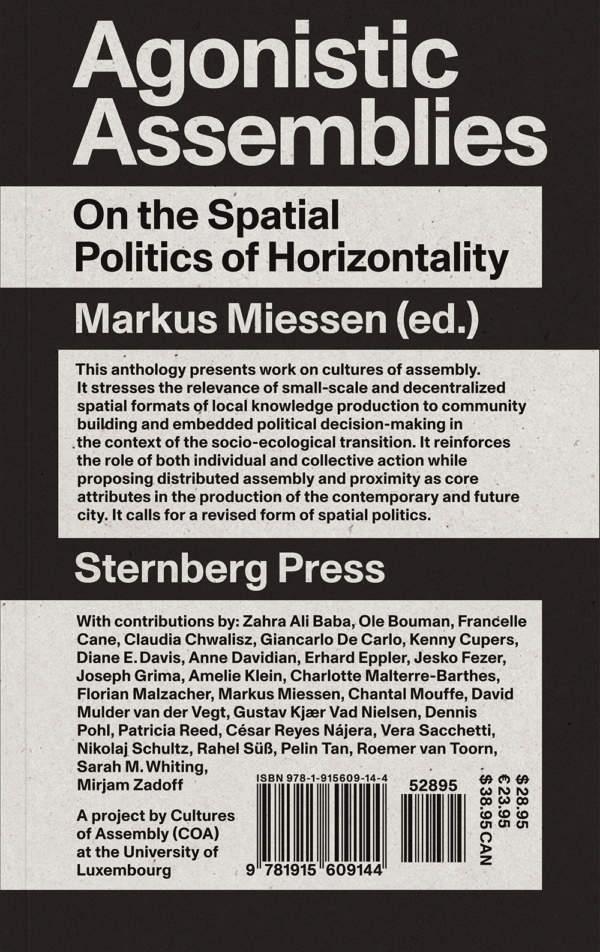
Une approche curatoriale des cultures délibératives d'assemblée et un scénario réaliste de pouvoir et de prise de décision décentralisés (anthologie éditée par Markus Miessen).This anthology presents work on cultures of assembly. It stresses the relevance of small-scale and decentralized spatial formats of local knowledge production to community building and embedded political decision-making in the context of the socio-ecological transition. It reinforces the role of both individual and collective action while proposing distributed assembly and proximity as core attributes in the production of the contemporary and future city. It calls for a revised form of spatial politics.Miessen's ongoing research trajectory Cultures of Assembly was initially kicked off during a Harvard GSD fellowship in collaboration with Joseph Grima, in which the two architects investigated the sociopolitical dimension of (urban) spatial design. Observing the Kuwaiti cultural and social landscape with a specific interest in the politico-spatial phenomenon of Diwaniya, this distributed urban form of para-institutional assembly established a starting point for a long-term body of research.Diwaniya can be understood and interpreted in multiple ways. Beyond a techno-futuristic idea of progress, it presents a showcase of an alternative that attempts to imagine a model of a (more) solidary city. On the scale of a city, and in fact small country, it interrogates how we-as a society-can learn from and produce alternative formats of physical exchange, working towards realistic scenarios of decentralized decision-making and spatial justice.Agonistic Assemblies asks: how can spaces-both physical and virtual-be envisaged to create publics? How is collectivity and society being generated spatially and in terms of policy? How do we practice society as a bodily, spatial form, and how does this practice contribute to spatial justice? Are there specific spatial settings that can intensify these practices? Wha
Informations sur cette offre
- Catégorie
- Loisirs · Livres
- État
- Neuf
- ISBN de cette édition
- 9781915609144
- Marchand
- Cultura FR